Architecture reference: initialization and record flow
This page documents the runtime behaviour of the logging system — how loggers are initialised and how records flow through the system.
For the static structure of components (HandlerType, Specs, Filters, Strategies), see the developer explanation.
Logger initialisation flow
When you build a logger and need to determine which handlers should be attached:
- You call
get_daq_logger(...)with flags likerich_handler=True,stream_handlers=True, etc. - Logger setup resolves which handlers to attach based on your flags
- For each handler type, setup:
- Looks it up in
HANDLER_SPEC_REGISTRYandFILE_SPEC_REGISTRY- Calls the factory function to build it - Attaches aHandleIDFilterwith the handler's routing identity - Installs it on the logger - The fallback set is composed from all enabled handlers. This becomes the default allowed set for records that don't carry explicit
extra["handlers"].
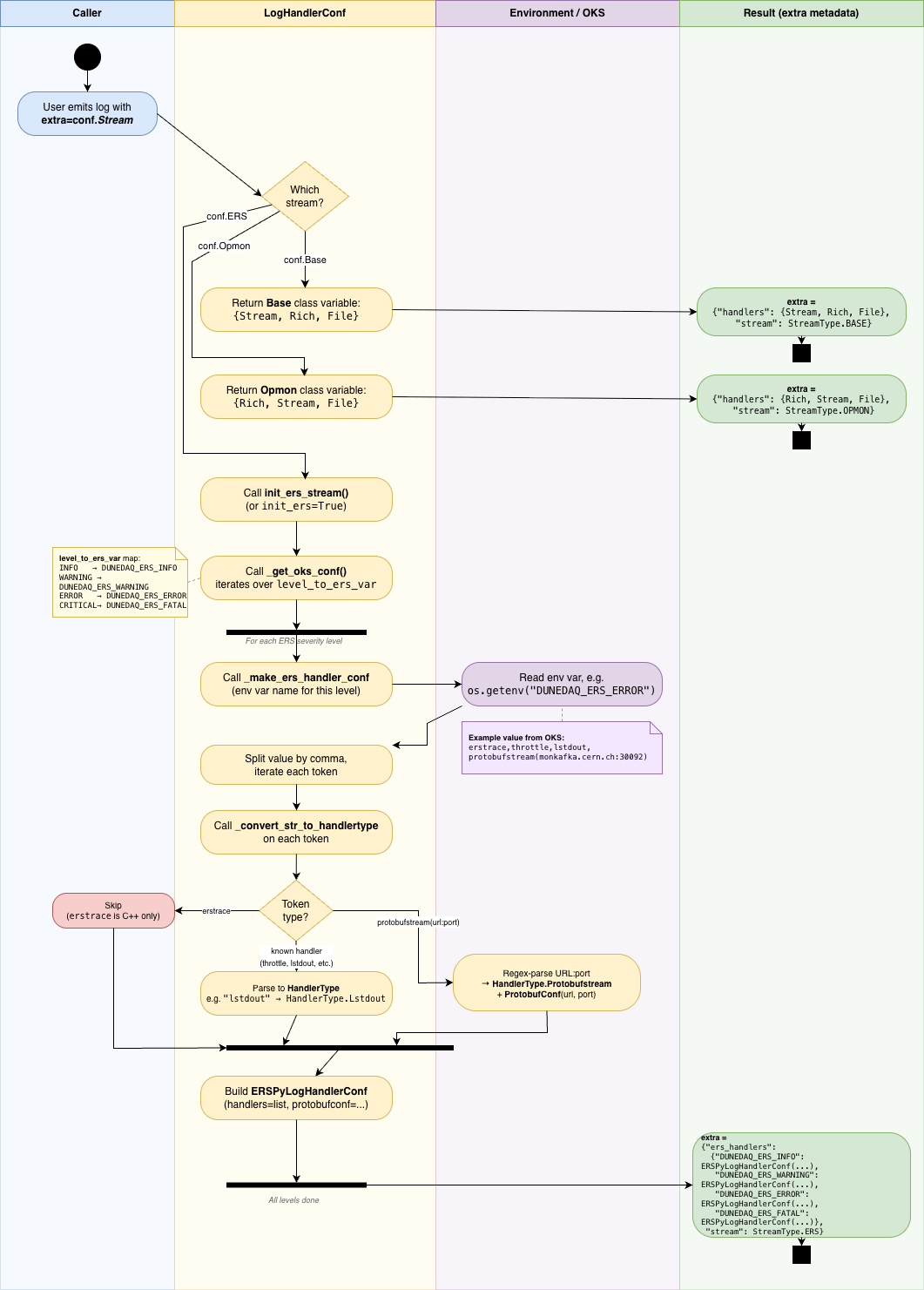
If you add ERS handlers via setup_daq_ers_logger(...), the process is similar but with a critical difference:
- ERS env variables are parsed (e.g.,
DUNEDAQ_ERS_ERROR=...) - Handler types are extracted from each severity's config (e.g.,
throttle,lstdout,protobufstream(...)) - Handlers are built and attached with
fallback_handler={HandlerType.Unknown}- This is the key: ERS handlers won't emit by default - They only emit when explicitly requested by ERS severity routing (seeERSAllowedHandlersStrategy) - This prevents accidental spillover into standard logging - Records are routed to ERS handlers only via ERS severity mapping
- A record marked
extra={"stream": StreamType.ERS}triggers ERS-aware routing - The routing strategy maps Python level → ERS severity variable → handler set
Record flow
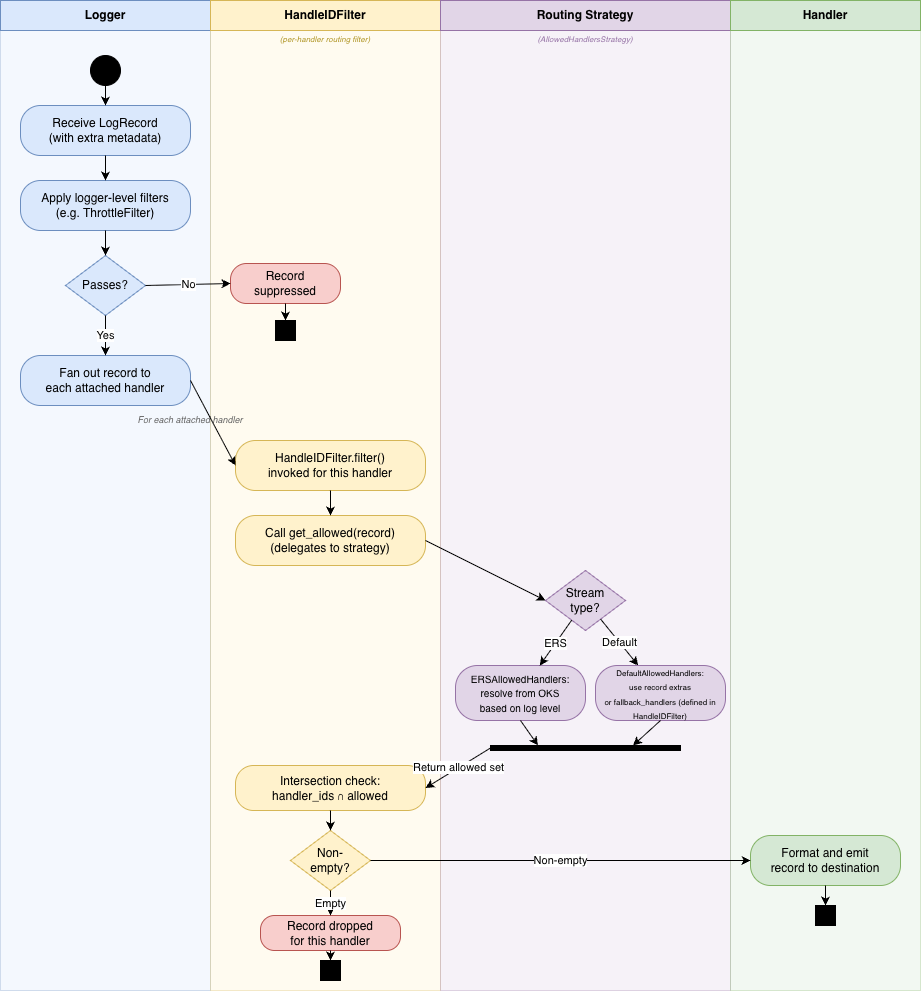
When you call log.info("something"), here's the actual flow:
-
Python's logging creates a
LogRecordwith your message, severity, and anyextrametadata -
Logger-level filters run first (e.g.,
ThrottleFilter):
- If any filter returns
False, the record stops here - It never reaches handlers
- This is where global concerns like throttling happen
-
Record is offered to each attached handler
-
Each handler's
HandleIDFilterdecides whether to emit:
- The filter calls the routing strategy to resolve
allowed_handlers:- If
extra["handlers"]is present, use it - Otherwise use the fallback set
- If
stream == StreamType.ERS, use ERS-specific routing
- If
- The filter checks:
handler_ids ∩ allowed_handlers - Non-empty = emit; empty = drop the record
- Format and emit (if the record passed the filter):
- The handler formats it and emits (to file, stdout, kafka, etc.)
This two-stage filtering is key: logger-level filters decide "should ANY handler see this?" while handler-level filters decide "should THIS handler see this?"
Practical example
Here the practical logic flow is explained more with demonstrations.
Lets say we have a logger that contains both a Rich and File handler, and we explicitly define what the fallback handlers is.
from daqpytools.logging import add_handler, HandlerType, get_daq_logger
log = get_daq_logger(
    "myapp",
    log_level="INFO",
    rich_handler=False,      # deliberately don't add handlers, we'll do it manually
)

add_handler(log,
   HandlerType.Rich,
   use_parent_handlers=True
   fallback_handler={HandlerType.Rich} # default behaviour
   )
add_handler(
    log,
    HandlerType.File,
    use_parent_handlers=True,
    fallback_handler={HandlerType.File} # default behaviour
)
And now we investigate what happens if we send a log message with log.info("msg", extra={"handlers": HandlerType.Rich}). Here, the log message will be sent to both the Rich and File handlers for processing. In each handler, it will check to see what the allowed handlers are (lets call it handlers_to_check_against). In this case, since we set it explicitly when sending the mesage, handlers_to_check_against = HandlerType.Rich.
For the Rich handler, it checks if the Rich handler is in the handlers_to_check_against list. In this case, it is, so it will transmit.
For the File handler, it will check if the File handler is in the handlers_to_check_against list. In this case, the file handler is not in the list so it will not transmit the record.
Using the same setup, lets investigate what happens if we send a log a log message with log.info("msg"). In this case, the handlers keyword is not explicitly populated.
In this example, the record is sent independently to the two handlers. Since the handlers keyword is not set, the logic that populates handlers_to_check_against will check the fallback_handlers that are attached to each handler.
In the rich handler, we have initialised it with a fallback_handler of HandlerType.Rich, so handlers_to_check_against = fallback_handler = HandlerType.Rich. The rich handler will then check if the rich handler is in the handlers_to_check_against, which it is. So it will transmit the record.
In the file handler, we have initialised it with a fallback_handler of HandlerType.File, so handlers_to_check_against = fallback_handler = HandlerType.File. The file handler will then check if the file handler is in the handlers_to_check_against, which it is. So it will transmit the record.
This sounds a bit circular, but the reasoning for this should become clear in the case where we set different fallback handlers. Consider the following setup, where the only difference is that we set the the file handler's fallback_handler to HandlerType.Unknown:
from daqpytools.logging import add_handler, HandlerType, get_daq_logger
log = get_daq_logger(
    "myapp",
    log_level="INFO",
    rich_handler=False,      # deliberately don't add handlers, we'll do it manually
)

add_handler(log,
   HandlerType.Rich,
   use_parent_handlers=True
   fallback_handler={HandlerType.Rich} # default behaviour
   )
add_handler(
    log,
    HandlerType.File,
    use_parent_handlers=True,
    fallback_handler={HandlerType.Unknown} # Suppressing behaviour!
)
Transmitting log.info("msg", extra={"handlers": HandlerType.Rich}) will yield identical results to before. However, transmitting log.info("msg") yields different results.
As before, the log record is independently fed towards the two handlers. For the rich handler, the flow is identical and so it will transmit.
In the case of the file handler, we have initialised it with a fallback_handler of HandlerType.Unknown, so handlers_to_check_against = fallback_handler = HandlerType.Unknown. The file handler will then check if the file handler is in the handlers_to_check_against = HandlerType.Unknown, which it is not as HandlerType.File is not in HandlerType.Unknown. So it will suppress the record.
This has a very useful suppression effect, allowing the handlers to remain dormant by default. The only way to transmit with the file handler now is only if it was explicitly called for, by log.info("msg", extra={"handlers": HandlerType.File})